West County, MO
Signs Your West County Basement Wall Is Failing (Not Just Cracking)
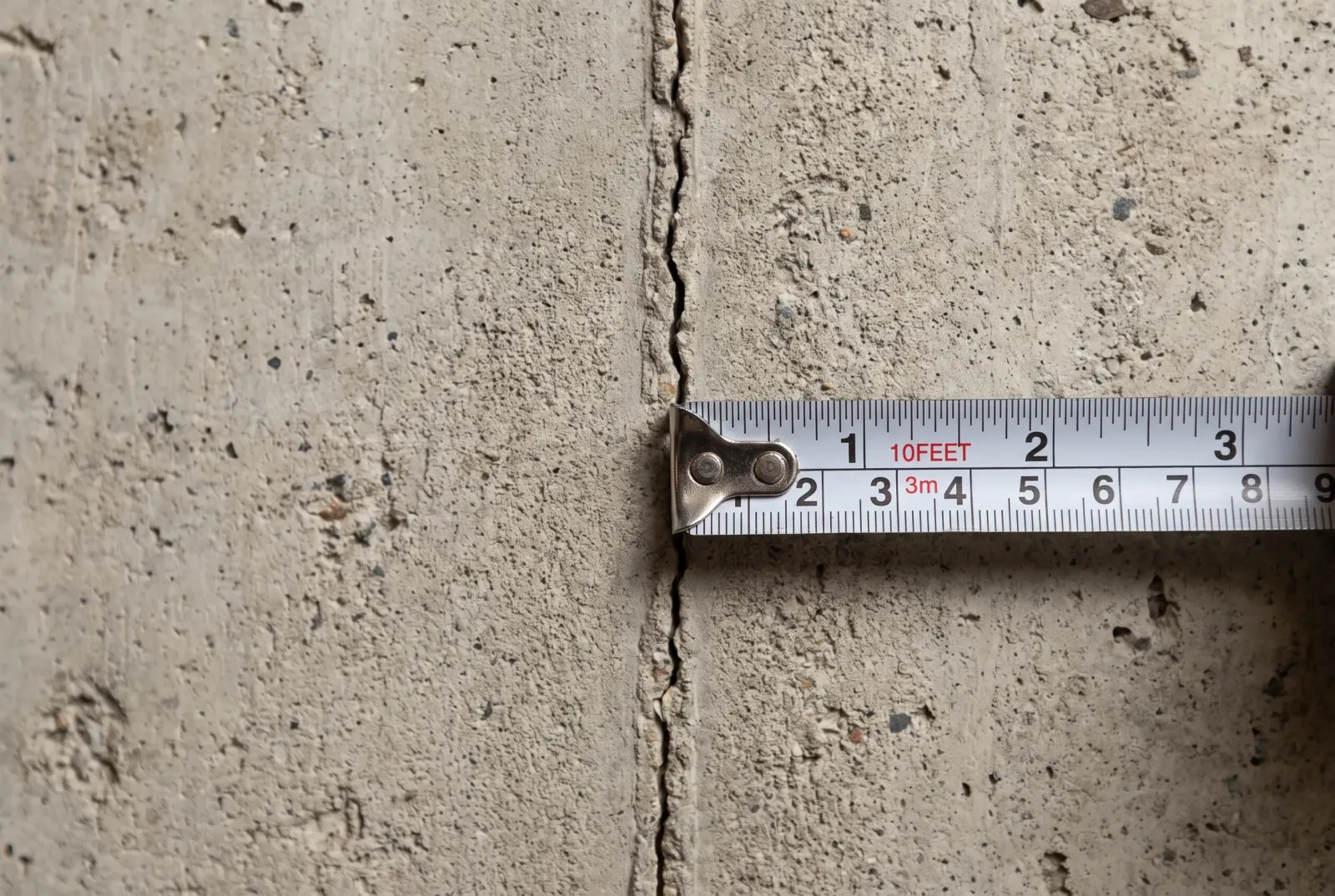
Almost every poured-concrete foundation in West County develops at least one hairline crack in its first few years, and most of those cracks never become a problem. Signs your basement wall is actually failing look different from a normal crack: they involve direction, width change, and movement over time, not just the presence of a line in the concrete. Here is how to read your own wall before you decide whether it needs a phone call or just a note on the calendar.
Types of Foundation Cracks — Which Ones Are Normal
A vertical crack that runs straight up and down, stays roughly the same width from top to bottom, and is under about 1/8 inch wide is usually shrinkage. Poured concrete loses water as it cures over its first year or two and contracts slightly as it does; a thin vertical crack from that process is cosmetic in the vast majority of West County homes. A vertical crack that is wider at the top than the bottom (or vice versa), or one that has visibly grown since you first noticed it, is a different animal — it is telling you the two sides of the crack are no longer moving together.
Horizontal and Stair-Step Cracks Are a Different Signal Entirely
A horizontal foundation crack — one that runs sideways across a block or poured wall, usually a few courses up from the floor — is not a shrinkage crack under any circumstance. It is the signature of lateral pressure pushing the wall in from outside, which in West County almost always means expansive clay soil swelling against the wall after a wet stretch. A stair-step crack that follows the mortar joints diagonally in a block or brick foundation is the same story in masonry: differential settlement or lateral pressure moving one section of the wall relative to another. Neither of these belongs on a "monitor it" list without an engineer weighing in first.
Bowing: The Sign You Can See Without a Tape Measure
A wall does not have to crack to be failing — it can simply push inward as a single unit, especially block walls under sustained clay pressure. Stand at one end of the basement and sight down the wall: a visible inward curve, or a wall that is noticeably out of plumb compared to the corner, is bowing. Most engineers treat anything over roughly 1 inch of deflection across 8 feet of wall height as worth a structural opinion, and anything past 2 inches as active. A wall that has bowed slowly over 15 years and stopped is a different repair conversation than one that moved 3/4 inch in the last two years — rate of movement matters as much as the current number.
Signs of Foundation Problems Away From the Wall Itself
Foundation movement rarely stays contained to the basement. A door that has started sticking only on one side of the house, a window frame that has gone out of square, a gap opening up where a wall meets the ceiling, or a floor that has developed a noticeable slope are all downstream signs of the same underlying movement. The tell that separates this from ordinary seasonal wood-swelling is pattern: humidity makes one or two doors stick in summer and free up in winter, while foundation movement tends to affect several openings on the same side of the house at the same time and does not resolve when the weather changes.
Why West County's Clay Soil Makes This Worse Than It Looks Elsewhere
West County sits on some of the most reactive clay in the Midwest. That clay swells as it absorbs water every wet spring and shrinks as it dries out every August, and a foundation wall built against it takes the pressure twice a year, every year. A crack or a degree of bowing that would be a one-time settlement event on stable sandy soil is, here, a cycle that repeats and compounds — which is exactly why a crack that looked stable last fall can be measurably wider by the following spring, and why "wait and see" needs an actual measurement behind it, not a memory of what the crack looked like six months ago.
When to Stop Watching and Call Someone
Treat it as urgent if the crack is horizontal, if water is actively coming through it, if the wall has visibly bowed further since you last looked, or if the movement showed up suddenly rather than gradually. Treat it as worth scheduling — not an emergency, but not nothing — if you have a stable-looking bow, a vertical crack that has grown, or new sticking doors on one side of the house. Either way, the honest first step is the same: get the wall measured by someone whose fee does not depend on what the diagnosis turns out to be.
Want a straight answer on what your wall is actually doing, from someone who is not also bidding the repair? An independent inspection measures the movement and tells you whether it is piers, bracing, or nothing yet — in writing, before anyone quotes a number.
Related Reading
- What Causes Foundation Settling in West County, MO
- Chesterfield Bowing Basement Wall Repair
- Piering vs. Mudjacking
- Wall Anchors vs. Carbon Fiber
- Free Basement Wall Crack Log & Bid Comparison Worksheet